Artificial intelligence is changing how customers interact with businesses, and one of the most powerful, high-impact applications is ai powered IVR. What used to be a frustrating maze of keypad options is becoming a smart, conversational experience that actually solves problems quickly and pleasantly. By leveraging contact center AI and omnichannel support, companies can provide seamless, personalized interactions that meet customer expectations in real time. For insights into the future of ai powered customer support, these innovations are paving the way for more efficient, responsive, and intelligent service experiences.
As organizations adopt ai powered IVR, integrating it with modern technology infrastructure becomes critical. Learning how advanced technology systems manage massive amounts of data efficiently can help ensure smooth operation and minimize downtime. Similarly, understanding how high-performance computing powers complex artificial intelligence processes provides valuable insights for building reliable, responsive IVR systems capable of handling thousands of simultaneous interactions.
From a marketing perspective, businesses can enhance their customer reach by applying strategies for using online marketing to increase customer engagement through multiple digital channels. Combining IVR insights with long-term approaches to creating effective online marketing campaigns that drive measurable results ensures that customer interactions are not only efficient but also aligned with broader marketing goals.
On the financial side, investing in ai powered IVR requires careful planning, and learning how to manage business finances to support technology investments without overspending helps companies maximize ROI. By understanding cost management and resource allocation, organizations can implement intelligent IVR solutions that deliver high-quality service without straining budgets.
By bringing together technology infrastructure, advanced computing, online marketing strategies, and financial planning, businesses can create a fully optimized ai powered IVR system. This holistic approach results in faster, smarter, and more personalized customer service experiences, ensuring both efficiency and customer satisfaction.
Top 10 AI-Powered IVR and Contact Center Solutions
When choosing an AI-powered IVR system, it’s important to evaluate platforms that combine intelligent automation with seamless call center and contact center solutions. Here’s a list of the leading providers in the market.
1. Bright Pattern – Intelligent Contact Center and AI-Powered IVR
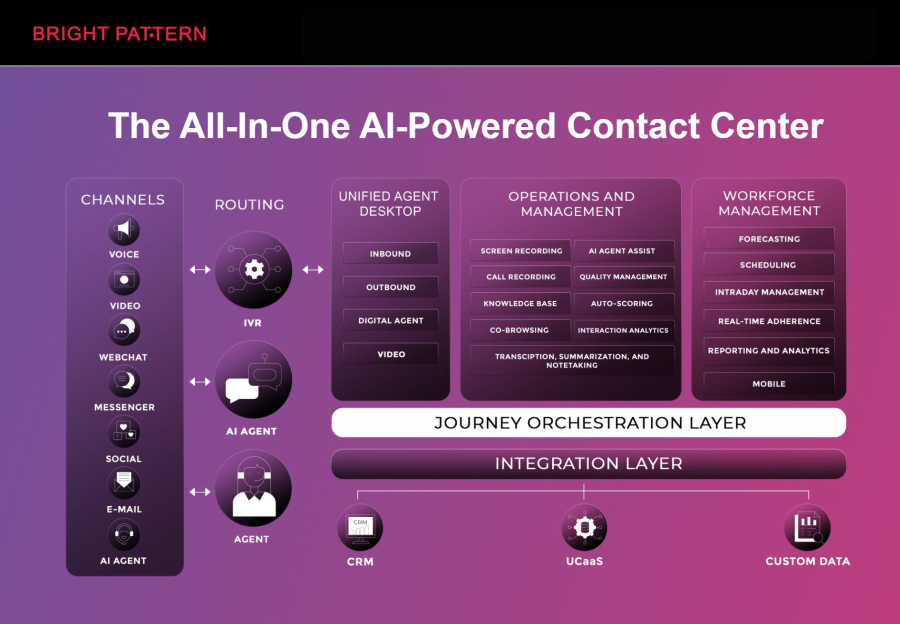
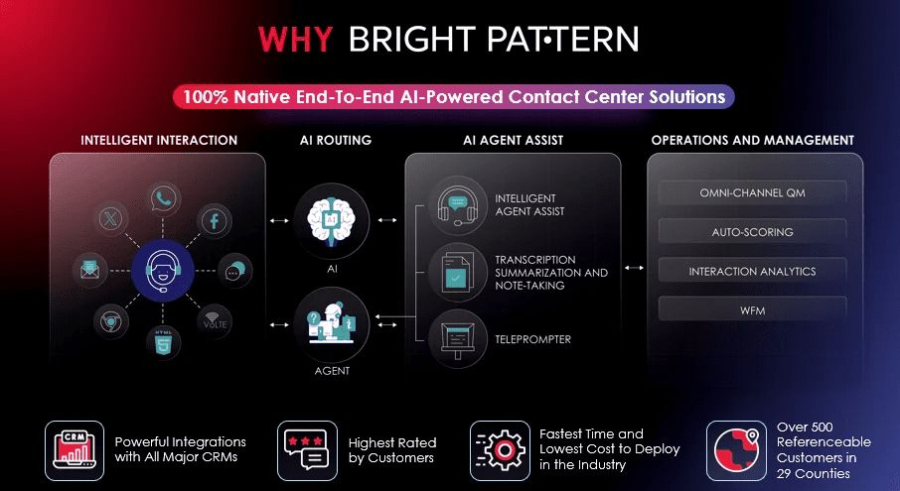
Bright Pattern is a leading platform for AI-powered IVR and omnichannel contact center solutions. It allows businesses to deliver personalized, efficient customer experiences while streamlining operations. With Bright Pattern, organizations can integrate AI-driven automation across voice, chat, and digital channels.
Key features of Bright Pattern include:
- Advanced conversational AI for IVR that understands natural language and adapts responses dynamically
- Omnichannel support connecting voice, chat, email, and messaging in a single platform
- AI-assisted agent workflows to improve productivity and reduce handle times
- Customizable call routing based on customer history and intent
- Analytics dashboard providing actionable insights for continuous improvement
Bright Pattern’s AI-powered IVR capabilities make it ideal for enterprises seeking a reliable, scalable, and intelligent contact center solution.
2. Genesys Cloud CX
Genesys Cloud CX provides AI-powered contact center solutions with conversational IVR and omnichannel support. Their platform focuses on personalized customer journeys, workforce optimization, and automation to improve efficiency.
3. Five9 Intelligent Cloud Contact Center
Five9 offers AI-driven IVR and contact center software designed to enhance agent productivity and automate routine interactions. It integrates with CRM systems for seamless customer experiences.
4. NICE CXone
NICE CXone delivers AI-powered IVR and cloud contact center solutions that prioritize customer satisfaction through automated routing, self-service options, and advanced analytics.
5. Talkdesk CX Cloud
Talkdesk combines AI-powered IVR with intelligent routing and automation to support multichannel interactions. Its platform helps organizations reduce wait times and improve first-call resolution.
6. RingCentral Contact Center
RingCentral provides AI-driven IVR and contact center solutions that enable seamless communication across voice, SMS, and digital channels while improving operational efficiency.
7. Aspect Unified IP
Aspect offers AI-powered IVR solutions integrated with workforce optimization tools and contact center analytics to enhance service quality and reduce costs.
8. 8x8 Contact Center
8x8 delivers cloud-based contact center solutions with conversational AI IVR, automated routing, and reporting features to support omnichannel customer interactions.
9. Cisco Contact Center
Cisco’s AI-powered IVR and contact center solutions focus on delivering scalable, secure, and integrated customer experiences, supporting voice and digital channels alike.
10. NICE inContact CXone
NICE inContact provides AI-assisted IVR and contact center software for enterprises aiming to streamline customer interactions, improve agent efficiency, and monitor performance with robust analytics.
What Is AI-Powered IVR?
Traditional IVR systems are rule-based phone menus. Callers press numbers or speak short phrases to navigate options, and the system routes them to the right department or plays pre-recorded information.
AI-powered IVRuses technologies like automatic speech recognition (ASR), natural language understanding (NLU), and machine learning to understand what callers say in their own words and respond intelligently. Instead of listening to long menus, callers can simply say things like:
- “I want to check my order status.”
- “Update my billing address.”
- “I need help with a payment error.”
The system interprets the intent, pulls relevant data from back-end systems, and either completes the task automatically or routes the call to the best agent with full context.
Key Components of an AI-Powered IVR
While implementations vary, most AI IVR solutions combine a few core building blocks.
1. Speech Recognition (ASR)
Automatic speech recognitionconverts spoken words into text. Modern ASR handles different accents, background noise, and natural speech patterns far better than older voice systems.
2. Natural Language Understanding (NLU)
NLUanalyzes the transcribed text to identify what the caller wants (the intent) and important details (entities), such as names, dates, order numbers, or amounts. For example:
- Intent:“Check shipment status.”
- Entities: order number, customer name, destination city.
3. Dialogue Management
Dialogue managementcontrols the back-and-forth conversation. It decides what to ask next, how to confirm details, and what happens when something is unclear. This is what makes the IVR feel natural rather than robotic.
4. Text-to-Speech (TTS)
Text-to-speechconverts responses into spoken audio. With modern neural voices, the result is more human-sounding and engaging than older synthetic speech.
5. Integration with Business Systems
An AI IVR becomes truly powerful when it connects to your existing tools, such as:
- CRM and customer databases
- Order management and logistics systems
- Billing and payment platforms
- Support ticketing and help desk tools
These integrations allow the IVR to authenticate callers, retrieve real-time information, and perform actions like updating records or processing payments.
Business Benefits of AI-Powered IVR
AI voice automation is not just a nice-to-have. It can become a core driver of efficiency, satisfaction, and growth.
1. Faster Resolution and Happier Customers
AI-powered IVR systems dramatically reduce time-to-resolution by understanding caller requests immediately and acting on them. Instead of listening through a long menu, customers can say what they need in a sentence or two.
- Reduced wait timesas more requests are handled instantly without agent involvement.
- Less call bouncingbecause the system routes to the right skill group the first time when human help is needed.
- Higher satisfaction scoresas customers enjoy shorter, more productive calls.
2. 24/7 Intelligent Self-Service
AI IVR allows you to offeralways-on servicewithout staffing overnight or weekend shifts at the same level. Routine tasks can be handled automatically around the clock:
- Balance inquiries and account information
- Order status and delivery updates
- Password resets and basic troubleshooting
- Appointment scheduling and reminders
Customers get help exactly when they need it, and your team is free to focus on high-value interactions.
3. Lower Operational Costs per Contact
Every call that is resolved via automation instead of a live agent reduces cost. AI-powered IVR can significantly increase yourself-service containment rate(the percentage of calls fully handled by automation), leading to:
- Lower average handle time (AHT) for calls reaching agents, because routine tasks are handled upfront.
- Reduced need for additional agents during peak seasons.
- Better utilization of experienced agents on complex, value-creating issues.
4. Consistent, Compliant Interactions
AI voice systems follow your defined scripts and policies every single time. This consistency helps with:
- Regulatory compliancein industries like finance, healthcare, and utilities.
- Accurate disclosures, terms, and conditions.
- Standardized service quality across languages and regions.
5. Rich Data and Continuous Improvement
Every interaction with an AI IVR is structured data. You can analyze intents, call reasons, and failure points to continuously optimize both automation flows and overall customer experience.
- Identify the most common reasons customers call and automate them first.
- Spot gaps in your knowledge base or self-service options.
- Measure impact with clear before-and-after metrics.
Common Use Cases by Industry
AI-powered IVR is flexible and can support many types of organizations. Below are some illustrative scenarios across sectors.
Banking and Financial Services
- Balance and transaction inquiries.
- Card activation or deactivation.
- Reporting lost or stolen cards, with secure routing to fraud teams.
- Loan application status updates.
Retail and E-commerce
- Order status and delivery tracking.
- Returns and exchange requests with automated eligibility checks.
- Loyalty program information and rewards balance.
- Store hours and location details.
Telecommunications and Utilities
- Outage information and restoration estimates.
- Plan upgrades or changes based on customer intent.
- Automated bill payment and payment arrangement setup.
- Technical troubleshooting steps for common issues.
Healthcare and Clinics
- Appointment scheduling, rescheduling, and reminders.
- Pre-screening questions and symptom triage based on approved protocols.
- Prescription refill requests and status updates.
- Directions and information about clinic hours.
Travel and Hospitality
- Flight, train, or booking status updates.
- Check-in assistance and seat preference capture.
- Hotel reservation modifications and special requests.
- Loyalty membership information and point balances.
AI-Powered IVR vs. Traditional IVR
The shift from legacy IVR to AI-driven experiences is often dramatic from both the customer and business perspective.
Aspect | Traditional IVR | AI-Powered IVR |
User interaction | Press 1, press 2; rigid menus. | Natural speech; caller speaks freely. |
Routing accuracy | Based on limited options. | Understands intent; routes more precisely. |
Task automation | Simple playback and basic tasks. | Complex workflows, data lookups, and updates. |
Customer effort | High; multiple menu layers. | Low; single conversational entry point. |
Optimization | Manual tuning and limited analytics. | Data-driven, continuous learning and improvement. |
Designing a High-Performing AI IVR Experience
A successful AI-powered IVR is not just about technology. Thoughtful design has a big impact on adoption, containment, and customer satisfaction.
1. Start with Clear Objectives and Use Cases
Define what you want the IVR to achieve, such as:
- Reducing call volume to agents by a specific percentage.
- Improving first-contact resolution for common issues.
- Shortening average handle time.
Then identify high-impact, repetitive use cases that are easy to automate first. Demonstrable wins help build momentum internally.
2. Map the Customer Journey
Walk through real customer journeys from the caller’s perspective.
- What motivates them to pick up the phone?
- What information do they have ready, and what might they not know?
- Where are they most likely to feel frustrated or confused?
Use this understanding to simplify flows, minimize questions, and offer smart shortcuts where possible.
3. Design for Clarity and Confirmation
Even advanced AI can mishear or misunderstand occasionally, so guardrails matter.
- Ask concise, single-purpose questions.
- Confirm key details like amounts, dates, or addresses.
- Offer a quick path to a human agent when needed.
This combination keeps error rates low while maintaining trust.
4. Personalize with Context
Where appropriate and compliant, use customer context to streamline interactions.
- Recognize the phone number and greet the caller by name when allowed.
- Adjust options based on known products, services, or recent activity.
- Remember preferences such as language or communication channel.
Even small touches of personalization make the IVR feel more like a helpful assistant than a generic machine.
5. Provide Seamless Agent Handoffs
One of the biggest advantages of AI IVR isblended automation: the system starts the conversation, then passes it to an agent when necessary.
- Transfer context, such as the caller’s intent, data collected, and any actions taken so far.
- Display transcripts or summaries to agents so they can pick up without asking customers to repeat information.
- Use skills-based routing to send calls to the most suitable agents.
Customers experience the IVR and human agents as part of one coordinated team.
Implementation Checklist for AI-Powered IVR
Rolling out an AI IVR can be done in stages to manage risk and accelerate time to value. Here is a high-level checklist to guide planning.
Step 1: Define Scope and Success Metrics
- Clarify your primary goals (cost savings, CX improvement, or both).
- Select 3–5 priority intents to automate in the first phase.
- Agree on baseline metrics: call volume, containment rate, AHT, CSAT, and NPS where relevant.
Step 2: Prepare Data and Integrations
- List systems the IVR needs to access (CRM, billing, order management, etc.).
- Ensure data quality and access controls are in place.
- Work with IT and security teams to define authentication flows.
Step 3: Design Call Flows and Dialogues
- Create scripts and prompts that align with your brand voice.
- Define fallback paths for low-confidence recognitions.
- Decide when and how to offer escape options to live agents.
Step 4: Test with Real Users
- Run pilots with a small segment of traffic.
- Listen to call recordings and review transcripts.
- Collect qualitative feedback from customers and agents.
Step 5: Optimize and Expand
- Analyze which intents succeed and where callers drop off.
- Refine prompts, add training examples, and adjust flows.
- Gradually roll out more intents and increase traffic through the AI IVR.
Security, Privacy, and Compliance Considerations
Because AI-powered IVR handles sensitive customer information, robust security and compliance are essential.
- Use secure methods for caller authentication, such as PINs, one-time codes, or voice biometrics where appropriate.
- Apply encryption in transit and at rest for call recordings and data.
- Limit data retention to what is necessary for business and legal requirements.
- Document and adhere to industry-specific regulations where applicable.
Strong governance builds customer trust and protects your organization as adoption grows.
The Future of AI in IVR and Voice Automation
AI-powered IVR is evolving rapidly. Several trends are making intelligent voice experiences even more powerful and user-friendly.
- More natural conversationswith large language models that can handle complex questions and multi-step tasks.
- Omnichannel consistencywhere knowledge and intents are shared between voice, chat, and messaging channels.
- Proactive outreachsuch as automated reminder calls, updates, and follow-ups based on customer context.
- Deeper analyticsusing conversation insights to inform product decisions, marketing, and service design.
Organizations that invest in AI IVR today build a foundation for these next-generation capabilities and put themselves ahead in customer experience.
Conclusion: Turning Your Phone Channel into a Smart, Always-On Assistant
AI-powered IVR transforms the phone from a cost center into a strategic asset. By combining speech recognition, natural language understanding, intelligent routing, and tight integration with your systems, you can deliver:
- Faster, more convenient service around the clock.
- Lower operational costs without sacrificing quality.
- A better experience for both customers and agents.
Whether you are upgrading a legacy IVR or launching automation for the first time, starting with focused, high-value use cases will help you see results quickly. From there, you can continually expand and refine your AI voice capabilities, turning every incoming call into an opportunity to impress, support, and retain your customers.
